Read · Recommended
20 books from 20 years in endurance sport
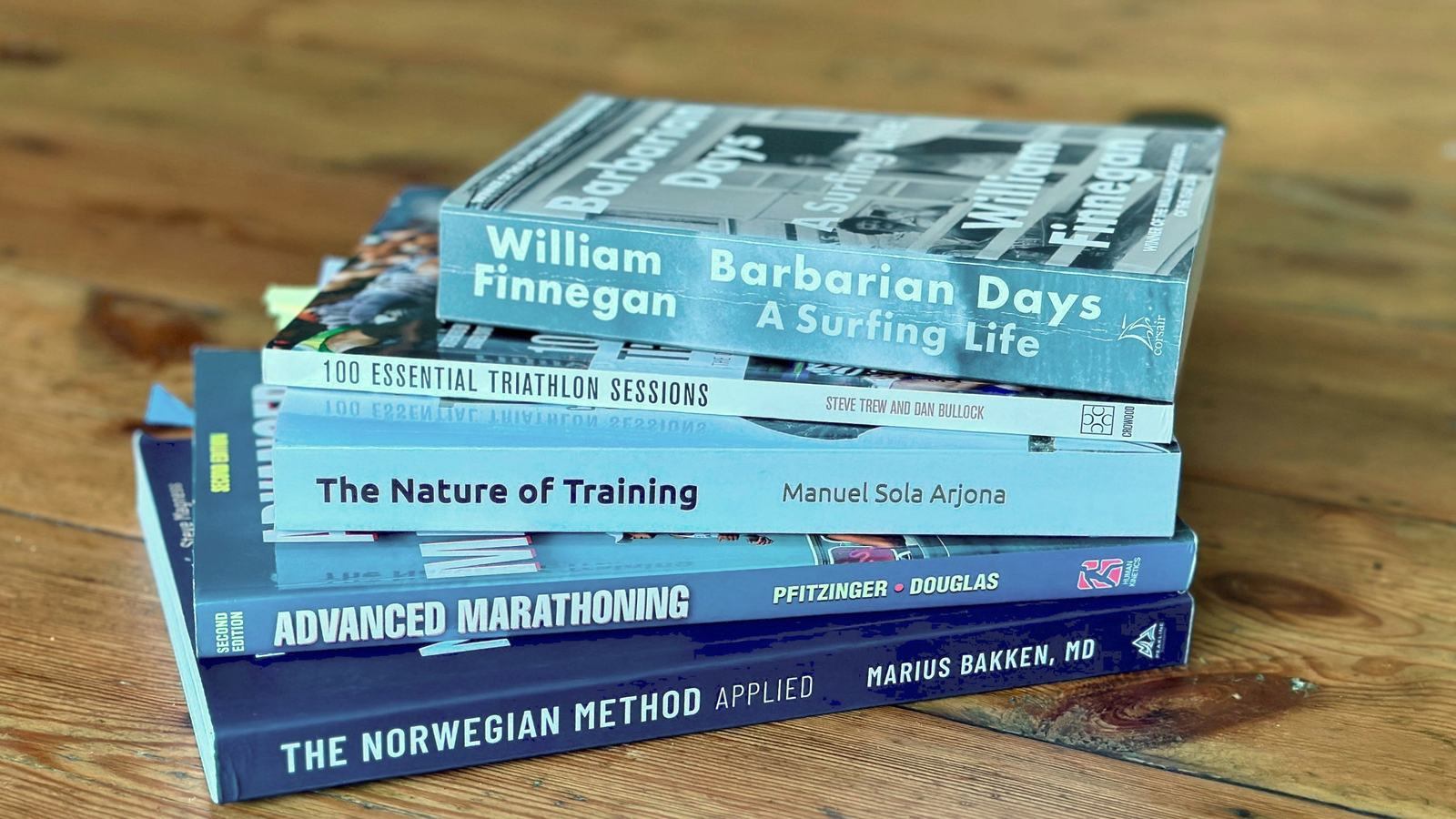
I took my first real steps into endurance sport in 2005. I'd competed to a high level in athletics and tennis as a teenager, but by my mid-twenties I was a long way from being an athlete. Twenty years later, after marathons, Ironman finishes and racing for Team GBR as an age-grouper, the books I've read along the way have shaped how I train as much as any coach or session.
So here are twenty of them, one for each year. Some are training manuals. Some have nothing to do with training at all. The test for every one was simple: would I hand it to an athlete today?
The twenty at a glance
They fall into five groups: how to structure training, how to measure it, the mind and its limits, the coaches and champions at the top of the sport, and why we do it at all.
How to structure training
Four books on planning the work: seasons, sessions and the blocks in between.
01
The Triathlete's Training Bible
by Joe Friel · 5th ed., 2024
Joe Friel is the coach of coaches, and the Training Bible is where his thinking is laid out most completely. He has unparalleled experience across running, cycling and triathlon. His books were the starting point for my own journey in marathon and Ironman training.
02
100 Essential Triathlon Sessions
by Steve Trew and Dan Bullock · 2014
Steve Trew is the Godfather of British triathlon! A top-class runner in the Coe-Ovett middle distance era, a GBR coach when triathlon made its Olympic debut at the Sydney 2000 Games, and a long-time BBC commentator. Dan Bullock is a former national-level swimmer, a highly experienced coach, and the founder of Swim for Tri. The pair were my coaches when I first moved from marathon to triathlon, and guided me to five Ironman finishes and a place in the GBR age-group squad. This book is Steve and Dan in a nutshell: it's a timeless collection of key sessions across disciplines that gave me the foundation to train for multi-sports and challenged me to progress as a competitive athlete.
03
Advanced Marathoning
by Pete Pfitzinger and Scott Douglas · 4th ed., 2026
I read Advanced Marathoning in 2017 on the recommendation of Tom Naylor, co-founder of the Brighton Marathon. His mum had taken huge chunks of time off her marathon personal best at the time, and I adapted the core principles for Ironman training en route to my long-distance comeback. It's one of the few books that I've bought the updated version of! It's accessible for all, while being aimed at experienced runners aiming to compete at a high level.
04
The Norwegian Method Applied
by Marius Bakken · 2026
There's been a lot of hype about the 'Norwegian Method' and, to be more precise, the specific principles and practices used by a number of coaches and athletes. There have been plenty of myths, and plenty of myth-busting too. This book walks through, in Bakken's own words, his experience, methodology development and recommended application for different kinds of runner, from 'the recreational runner who wants more' to 'the ambitious runner'. While training with a lactate meter, or doing double threshold sessions, almost certainly isn't practical or sensible for most amateur athletes with a life outside training, there is far more to Bakken's methods. His ideas have progressed my thinking and influenced my training this season; but I know that I've barely scratched the surface of it. This book has quite literally been on my bedside table all year, and it will remain there for a while yet.
How to measure it
The numbers, the models behind them, and where they stop being useful.
05
Triathlon 2.0: Data-Driven Performance Training
by Jim Vance · 2016
I'm a self-confessed data, tech and science obsessive, so this was always going to make my list! Most of us collect power, pace and heart-rate data every single day. Vance asks the question that matters: what is it actually telling you? It helped me stop collecting numbers for their own sake and start using them to make decisions, from setting zones to pacing a race. That question, what does this number really mean for this athlete today, is at the heart of how I'm building LOAD.
06
Training and Racing with a Power Meter
by Hunter Allen, Andrew Coggan and Stephen McGregor · 3rd ed., 2019
If you've ever looked at a fitness, fatigue and form chart, you've met the ideas in this book. Allen and Coggan wrote the rulebook for training with power, and almost every training platform still runs on it. It taught me to pace the bike so there's still a run left at the end, which is a lesson every Ironman athlete learns, usually the hard way! Just as valuable, it made me appreciate how much a power number can't tell you about how you're really absorbing your training.
07
Thinking in Systems
by Donella Meadows · 2008
As the sub-title says, this book is a primer for anyone interested in systems thinking. I read Meadows in 2018 when I joined Stripe. It has been one of the most influential books on my approach to building tech companies. Its value has gone far beyond that: it's shaped how I view the world and how we humans live in and interact with it. I apply its ideas daily to how I think about building hypothesis-driven training phases, how I distinguish between goals and measures of progress, how I expect my body to adapt and what signals I receive for whether that's going to plan or away from it.
08
The Nature of Training: Complexity Science Applied to Endurance Performance
by Manuel Sola Arjona · 2024
I read this in early 2026. It was first published in Spanish, so I had to wait for the English translation! It resonated immediately because of its systems thinking approach. Sola Arjona's critique of reductionist approaches, where metrics give a one-dimensional picture of the athlete, the training and what's really going on, has given me the foundation for re-evaluating the entire corpus of endurance sports training. It's also given me the belief to back my intuition rather than going purely by the numbers. It landed at a time when the numbers were misleading me, and I needed to get back to trusting my body and how I felt (winter base training lessons). Many of his ideas have directly shaped what I want LOAD to offer athletes: a coach that reasons through your training with you rather than an algorithm reacting to data, and that treats the questions and decisions athletes make as data, to get closer to measuring real life.
The mind and its limits
Why so much of endurance happens between the ears.
09
Endure
by Alex Hutchinson · 2018
If you've ever wondered why the last 10k of an Ironman marathon feels the way it does, start here. Hutchinson pairs the science with gripping stories, including his inside view of Nike's attempt to break two hours for the marathon. It changed how I think about the limits I hit late in a race: often it isn't that the body has nothing left, it's that the brain is deciding how much to give. That idea sits naturally alongside Strong Minds and The Experience Machine, and it's made me far more curious about the mental side of performance.
10
Strong Minds
by Noel Brick and Scott Douglas · 2023; first published 2021 as The Genius of Athletes
I used to compete at a GBR level in High Jump as a teenager. If ever a sport was a battle of mind over physical ability, with a very limited number of high stakes opportunities to perform, High Jump was it. And I loved it! I found I excelled at getting warmed up before a competition, then keeping my powder dry, being patient, and then using my three or four best attempts only when it mattered most for the competition at hand. I knew then that strong minds won the day. Ever since I started endurance sports I took this experience into my approach to training and competition. I read extensively on theory such as Noakes' "central governor" and how the body and the brain interact during intense endurance stress. Upon listening to Noel Brick on a podcast I found someone who was articulating intuitions I had felt for decades. Written with Scott Douglas, his book pairs sport psychology research with interviews with elite athletes, and turns both into mental skills anyone can learn: self-talk, motivation, focus, coping with pain and managing how hard effort feels.
11
The Experience Machine
by Andy Clark · 2023
I've spent the last few years working deeply in artificial intelligence (AI), partnering with frontier labs and applied AI startups to train, fine-tune, stress-test and monitor state-of-the-art models. Given my sporting background and fascination with how the mind and body work, I've become obsessed with reading about the science of how the brain works. Clark's book is probably the best foundational text on the Predictive Processing model and is the baseline for how the brain might actually create the world around it. I've since been inspired to read books by Paul Bloom, Max Bennett, Judea Pearl and Blaise Agüera y Arcas. Start with Clark!
12
Survival of the Fittest
by Mike Stroud · 1998, revised 2004
I had the fortune to meet Sir Ranulph Fiennes in 2004 and have always been inspired by his accomplishments as one of the greatest living explorers. Professor Mike Stroud's book draws on his own experiences accompanying Fiennes on gruelling expeditions ranging from polar expeditions to running 7 marathons in 7 days on 7 continents. This seminal book pairs insights from each challenge with the science behind it.
Coaches and champions
The people at the top of the sport, and how they got there.
13
Running with the Legends
by Michael Sandrock · 1996
One for the aspiring history buffs! This was recommended to me by a close friend who, like me, had just embarked upon distance running in his mid-20s with only childhood experiences to draw on. This was the pre-YouTube era so the real stories behind the famous distance runners in history were not readily available. The portraits of the names I grew up admiring in the 80s and 90s were great, but I drew most inspiration from Priscilla Welch: served in the British Army and didn't take up competitive running until she was 35, yet went on to finish 6th in the Los Angeles Olympics marathon, setting a British record, aged 39.
14
Iron War
by Matt Fitzgerald · 2011
My introduction to triathlon was Mark v Dave. I'd watched the videos and listened to the interviews, but I was missing the in-depth insight into every stroke, pedal revolution and step taken by two of the greatest Ironmen in history, on the way to and during one of the most sensational duels in sport. Fitzgerald cuts between the eight hours of the 1989 race and the two men's very different lives, then steps back to explain the science of what their bodies and minds were going through. As both a writer and an endurance coach, he's the right person to bring this story to life.
15
A Life Without Limits
by Chrissie Wellington · 2012
Chrissie was one of my biggest inspirations when I first got into triathlon, and I've been lucky enough to meet her several times through my first coach, Steve Trew. Her performances were extraordinary, but it was her background that really struck a chord with me. She came to the sport late, from a career in government and international development, raced as an age-grouper, and then won in Hawaii at her very first attempt. Proof that you don't need to have been a lifelong athlete to reach the very top! Her honesty about setbacks, and that famous smile through all of it, is a lesson for any of us.
16
We Share the Sun
by Sarah Gearhart · 2023
I first heard about this book when Matt Fitzgerald interviewed the author on his 80/20 podcast, and I ordered it straight away. Patrick Sang coaches the whole person, not just the runner. His athletes live and train together at Kaptagat, and their lives outside running matter as much as the sessions they run. Reading about his philosophy changed how I think about what makes a training session valuable, and how my sport fits into my personal, professional and family life. That whole-life approach is exactly what I believe coaching should be, and it's the thinking behind LOAD. If you enjoy it, read Michael Crawley's Out of Thin Air alongside it. Crawley, an anthropologist, spent 15 months training with runners in Ethiopia. Together the two books show both sides of East African distance running: Kenya and Ethiopia, the coach's view and the outsider's.
Why we do it
The reasons we keep coming back, which have little to do with a training plan.
17
Feet in the Clouds
by Richard Askwith · 2004
I read Askwith's book in 2005, as I was taking my very first steps towards a life in endurance sports that I could not have imagined at the time. I had competed to a high level in athletics and tennis as a teenager, but by then I was far from being an athlete. University, an early career in newspapers and then tech startups, and a London social life were not conducive to a healthy, active life. Then I read Feet in the Clouds, and it changed not only my exercise regime but my life, forever. I went on to find motivation in performance and competition, but it all started with the joie de vivre Askwith conveys. Don't get me wrong: fell runners race, strive to win and try to better their times, and there are prizes. But the intrinsic motivation driving the people in his stories is about more than the time, the medal or the bragging rights. It's primal, and it's beautiful. This is the book that lit the fire in me, and it still burns bright today.
18
What I Talk About When I Talk About Running
by Haruki Murakami · 2008
I read 50 to 60 books a year, and in my university days I aspired to be a writer. Murakami has always made the craft look simple. I'd read seven or eight of his best-known novels and held him in high regard as a novelist. Little did I know he was a kindred spirit! He took up running in 1982, aged 33, soon after selling his jazz bar to write full-time, and has run roughly a marathon a year ever since. Written while he trained for the 2005 New York City Marathon, the book ranges over a solo run from Athens to Marathon, a 100 km ultramarathon at Lake Saroma and his triathlon racing. Running, he argues, taught him what writing needs: focus, endurance and showing up every day. He even proposes his own epitaph: "At least he never walked."
19
Higher Calling
by Max Leonard · 2017
I read this while staying in the mountains outside Nice, the perfect place to be inspired by the roads Leonard brings to life. His writing is beautiful: it evokes the majesty of the mountains and the draw of cresting them. It captures the thrill of the climb, the desire to reach the summit, and the power that comes from being out in the elements.
20
Barbarian Days
by William Finnegan · 2015
This ranks among my all-time favourite books of any genre, and it was my number one read of 2020 (perhaps not surprising, given what the world was going through with Covid). It gets to the heart of what it means to want something: to be driven, to your very core, to pursue something for nothing more than the satisfaction it brings. Finnegan has been a staff writer at The New Yorker since 1987, reporting on wars and conflicts in Africa and beyond, and the book won the 2016 Pulitzer Prize for Biography. He brings that reporter's precision to his own life, describing waves, reefs and swells with the care other writers save for people, while being honest about the selfishness an obsession demands. It is the closest thing I've read to conveying what gives a person's life meaning and purpose.
What they have in common
Looking back across twenty years, the books that stuck aren't the ones with the cleverest plans. They're the ones that treat the athlete as a whole person: someone with a job, a family, a mind that sometimes gets in the way, and a reason for doing this that no number can capture. Friel and Coggan gave me the structure and the measures. Meadows and Sola Arjona showed me why those measures only ever tell part of the story. And Askwith, Murakami and Finnegan reminded me why I fell for all of this in the first place. That's the balance I'm still trying to strike in my own racing, and in LOAD.
What I'm reading now
Right now it's mostly fiction and history, which is probably the sign of a good off-season! I don't know yet which book will be the next to change how I train. If there's one that changed how you train, I'd love to hear about it: [email protected].